




What is the first thing that pops to mind when you think of rhinoplasty? Many people think of it as a cosmetic procedure, and this is true. However, there are cases where it is performed to solve a functional problem.
When your nasal anatomy interferes with regular airflow, you can consider rhinoplasty to improve your breathing, and it might actually be part of a broader treatment plan. Understanding how the nose works in terms of respiration will help you understand when surgery is appropriate. You will also be able to set realistic expectations, which is very important.
A systematic review of the literature found substantial evidence that modern functional rhinoplasty techniques are effective for treating nasal obstruction due to structural issues such as nasal valve collapse, supporting the use of rhinoplasty to improve nasal airflow in appropriately selected patients.
So, Can Rhinoplasty Help You Breathe Better?
Yes, rhinoplasty can most definitely help improve breathing, but only when breathing problems are caused by structural issues in the nose. A nose job performed for functional reasons focuses on correcting the internal anatomy rather than changing the outside appearance.
In these types of cases, the goal is to restore proper airflow. This is done by addressing physical obstructions. When a surgeon does it correctly, patients often report that it all makes breathing easier. They also say that they are experiencing fewer symptoms related to restricted airflow.
Understanding the Nose’s Role in Breathing
The nose plays a critical role in filtering, warming, and directing air into the lungs. Healthy nasal breathing depends on open and stable internal passages that allow air to move freely.
Problems within nasal structures, like narrow passages, can reduce airflow. These issues can also affect our sense of smell and sleep quality. You can’t sleep well if you can’t breathe well. The problem can go as far as to affect the patient’s overall sense of comfort.
Common Causes of Nasal Breathing Problems
Breathing difficulties often stem from internal nasal abnormalities. One of the most common causes is a deviated septum. This is a condition where the nasal septum is displaced to one side, which, in turn, blocks airflow.
Other causes include a weakened cartilage, narrow airways, or problems with the nasal valve (which is the narrowest part of the nasal airway). There are also other contributing factors, like trauma, a previous nasal surgery that was poorly executed, or natural anatomical variation.
What Is Functional Rhinoplasty?
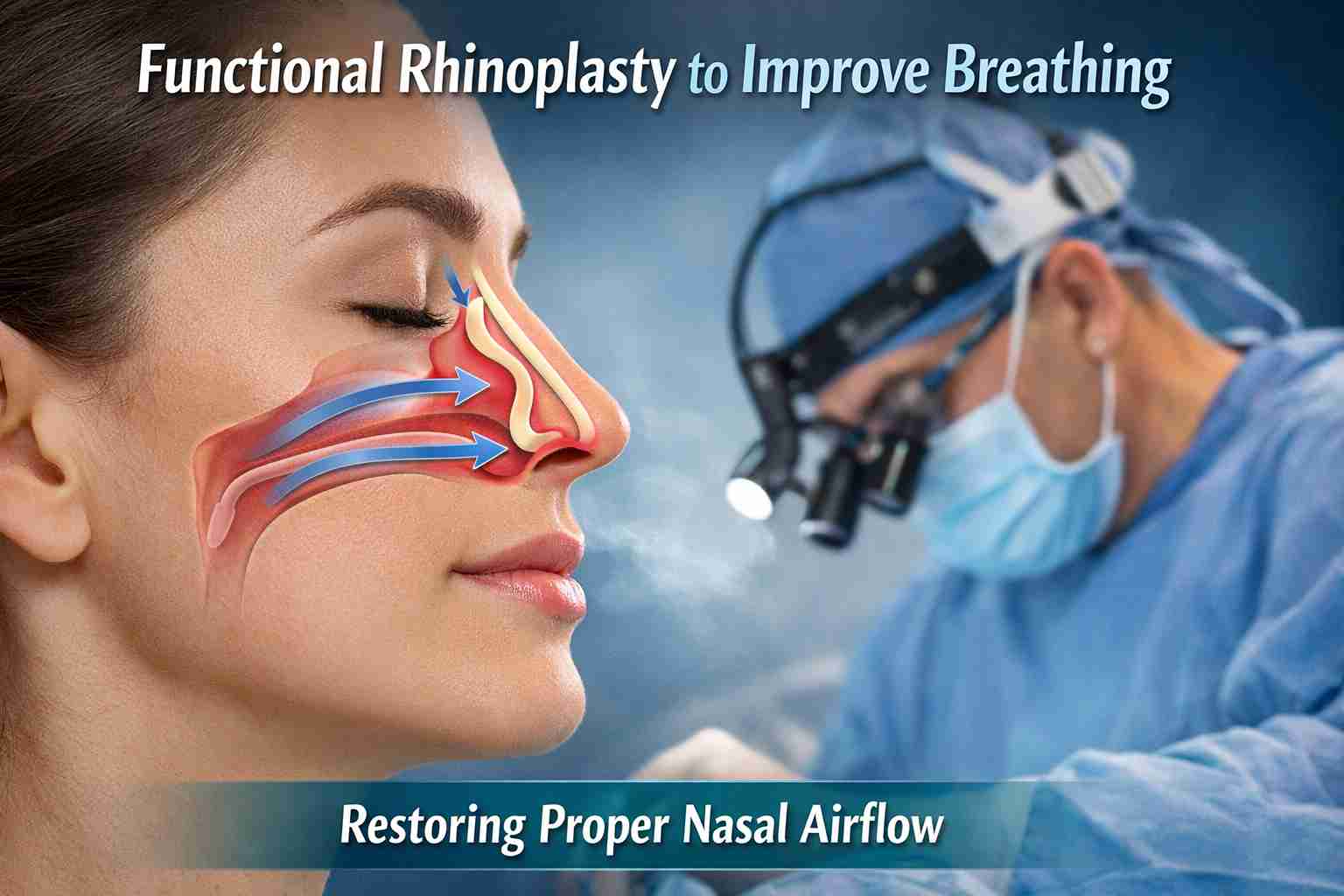
Functional rhinoplasty is a surgical approach that is designed specifically to improve airflow through the body while preserving or enhancing the patient’s overall appearance. Unlike procedures that are focused on cosmetics, this one focuses on correcting internal obstructions that interfere with breathing.
With this type of surgical procedure, the surgeon may attempt to strengthen your cartilage, widen your air passages, or stabilize weak nasal areas. The ultimate goal is to address breathing issues while maintaining a natural nasal structure.
Rhinoplasty vs. Septoplasty: What’s the Difference?
Septoplasty and rhinoplasty are often confused, but they serve different purposes. Septoplasty corrects deviations in the nasal septum without changing the external shape of the nose.
Rhinoplasty, on the other hand, involves reshaping the nose and may include septal corrections in certain scenarios. In some cases, you may need both procedures combined to resolve both functional and cosmetic concerns.
Here’s a quick table that clearly explains the difference.
Procedure | Primary Focus | Affects Appearance |
Septoplasty | Straightening the nasal septum | No |
Functional rhinoplasty | Improving airflow and support | Sometimes |
Combined approach | Form and airflow correction | Yes |
How Rhinoplasty Can Improve Airflow
The simple answer is that rhinoplasty can improve airflow by correcting narrow passages, reinforcing weak cartilage, and improving symmetry inside and outside the nose. Doctors often add structural support to prevent collapse and give the patients the ability to breathe normally.
When these adjustments are successful, airflow becomes much more stable. Patients report that their breathing has significantly improved. They can also notice less congestion, better sleep, and reduced effort when breathing through the nose.
Aesthetic vs. Functional Rhinoplasty: Finding the Balance
Modern nasal surgery is all about finding the perfect marriage between form and function. A skilled facial plastic and reconstructive surgery expert understands that appearance and breathing are closely connected and intertwined.
In many real cases, functional improvements can be made without dramatic changes to the patient’s facial appearance. But when a patient requests cosmetic adjustments, they need to be planned carefully to support airflow. If not, the adjustments might end up compromising normal breathing, and nobody wants that.
This balanced approach is a core principle of plastic and reconstructive surgery.
Signs You May Need Rhinoplasty for Breathing Issues
It can be very frustrating when you’re constantly fighting for air. If your breathing issues are caused by the structure of your nose, you might notice something like this.
- One-sided struggles: You feel like one nostril is permanently plugged.
- Constant congestion: You have a heavy, stuffed-up feeling that never seems to go away.
- The mouth breather effect: You find yourself breathing through your mouth because your nose just isn’t doing the job.
- Worsening at night or during a workout: If your breathing gets significantly tougher when you’re hitting the gym or trying to sleep, that’s a major red flag.
Risks and Limitations of Functional Rhinoplasty
As with any type of surgical intervention, this one carries some form of risk. Patients can experience swelling or temporary congestion. But fear not. These are all common during recovery. In very rare cases, your breathing may not improve as expected, and in such instances, you will probably need additional treatment.
Also, you should know that functional rhinoplasty is not a suitable solution for each and every breathing problem. You need a thorough evaluation from someone who has experience. This is essential to confirm whether surgery is likely to help or whether non-surgical options should be explored first.
This is the only way to get a result that will work well for your specific case.
FAQs
Can rhinoplasty really improve breathing?
Yes, of course. When breathing problems are caused by structural issues, a successful rhinoplasty can lead to noticeable improvements.
Is septoplasty better than rhinoplasty for breathing problems?
Septoplasty is effective when the septum is the main issue. Rhinoplasty is preferred when there are multiple nasal structures that affect the airflow.
How long does it take to breathe normally after rhinoplasty?
Breathing usually improves gradually over several weeks as the swelling goes down. The full results could take a few months.
Can rhinoplasty make breathing worse?
Yes, but only in rare cases, where improper surgical planning can affect the outcome. Choosing an experienced surgeon reduces this risk by a considerable margin.